
Home – Digital Brand Strategy 101: How to Stand Out in a Saturated Market
Explore how our team is breaking new ground and transforming the creative landscape with fresh, exciting solutions that make a real impact.
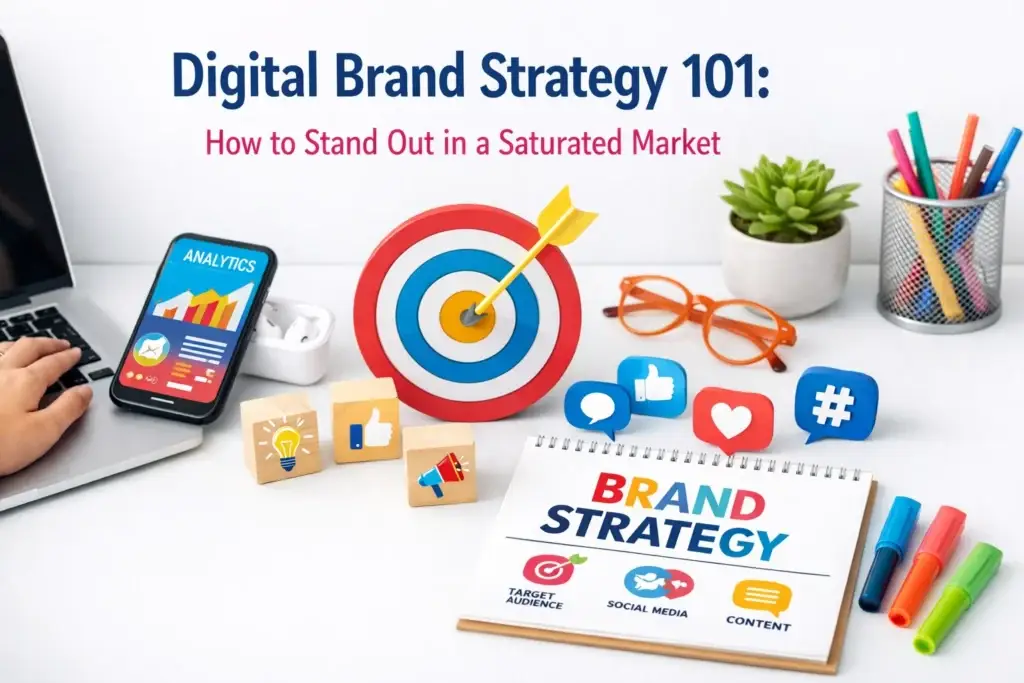
Let’s be real: the internet is a crowded room, and everyone is shouting for attention. As a visionary female founder, you’ve likely felt that “blank frame” moment where you know your business is spectacular, but you’re not quite sure how to make the world stop scrolling and notice.
The secret isn’t posting more frequently or chasing every viral trend like a caffeinated squirrel. The secret is a robust digital brand strategy.
A digital brand strategy is your high-level, long-term plan to achieve specific business goals through coordinated online efforts. It’s the difference between throwing spaghetti at a digital wall and hosting a curated five-course dinner for your ideal clients. If you want a deeper marketing lens on how strategy connects channels, funnels, and customer behavior, HubSpot’s resources on digital marketing strategy are a solid place to ground your plan in proven frameworks.
We love a good aesthetic as much as the next agency, but “vibes” are not a strategy. Without a clear plan, you’re just making pretty things that don’t convert.
In a saturated market, your digital presence needs to be more than just visually appealing; it needs to be intentional. Guessing is expensive; data is efficient.
When you operate without a strategy, you waste time on platforms your audience doesn’t visit and create content that doesn’t solve their problems. A well-defined digital brand strategy ensures that every pixel and every period serves a purpose. And when it comes to being found (instead of just being seen), Moz’s Beginner’s Guide to SEO is a trusted, no-fluff reference for building visibility with intent.

Before you even think about your color palette, you need to dig into the essence of your business. This is the foundation that keeps your brand standing when the marketplace gets shaky.
Draft your brand purpose. Why do you exist beyond making a profit? This is your “why,” and it’s the spark that attracts loyal followers rather than just one-time buyers.
Define your mission and vision. Your mission is what you’re doing today; your vision is where you’re going tomorrow. Positioning yourself as a forward-thinking leader requires a clear view of the 2026 and 2027 landscape.
Align with your core values. What do you stand for? Whether it’s radical transparency, sustainable luxury, or cutting-edge innovation, these values act as a filter for every business decision you make.
One of the biggest mistakes founders make is trying to talk to everyone. If you’re talking to everyone, you’re actually talking to no one.
To stand out, you must define your target audience with surgical specificity. Move beyond basic demographics like “women aged 30-45.” Instead, look for their “glow-up” aspirations and their late-night anxieties.

In a saturated market, you don’t need to be 100% better than your competitors; you just need to be 10% different in a way that matters. This is where your unique positioning comes into play.
Audit your competition. Look at what they are doing well and: more importantly: where they are dropping the ball. Are they too corporate? Too clinical? Too messy?
Simplify your unique selling proposition (USP). Can you explain why you’re the best choice in one sentence? If not, it’s time to refine. Your USP should highlight the specific benefits customers gain only from you.
By focusing on your specific “spark,” you move from being a commodity to being a category of one. Are you ready to stop competing and start leading?
Once the strategy is set, it’s time for the execution. This is where your digital brand strategy gets its “suit of armor.”
Build a consistent brand voice. Whether you’re witty and casual or sophisticated and authoritative, that voice must stay consistent across your services page and your social media captions. Consistency builds trust, and trust builds revenue.
Optimize your visual identity. Your logo, fonts, and colors should be a visual shorthand for your strategy. If your strategy is about “high-energy growth,” your visuals shouldn’t feel like a sleepy spa.
Streamline your digital home. Your website is your 24/7 salesperson. Make sure it’s up to the task. If you’re feeling like your current site is holding you back, check out our guide on how to optimize your website for SEO to ensure people can actually find you.

We are living in the future, and your digital brand strategy should reflect that. At Smart Brand Ideas, we specialize in helping founders leverage AI to scale their impact without burning out.
Integrate smart tools. From AI-driven analytics to 100 prompts for website designers, technology should empower your creativity, not replace it. Use AI to handle the “blank frame” moments so you can focus on high-level visionary work.
Think ahead. As we move deeper into 2026, the brands that win will be those that prioritize human connection alongside technological efficiency. It’s about using tech to be more human, not less.
How are you using the latest tools to give your brand a competitive advantage?
Ready to take your brand from “one of many” to “the only choice”? Use this checklist to audit your current path:

A digital brand strategy isn’t a “set it and forget it” document. It’s a living, breathing system that evolves as your business grows. It provides the flow and connection necessary to turn a cold audience into a thriving community.
If you’re feeling overwhelmed by the technical side of things, remember that every great visionary started with a single step. You don’t have to have it all figured out today, but you do have to start moving with intent.
Whether you are looking for a full brand overhaul or just want to explore different industries we’ve helped transform, the goal is always the same: clarity, impact, and growth.
What is the first step in a digital brand strategy?
The first step is always identifying your “why” and your target audience. Without knowing who you are and who you are for, the rest is just noise.
How long does it take to see results?
While some technical fixes (like SEO) can take a few months to show full impact, a clear strategy usually provides immediate clarity and better conversion rates on your current traffic.
Do I need a huge budget?
Not necessarily. Strategy is about being smart, not just spending. It’s about allocating your resources to the high-impact channels that actually matter.
How often should I update my strategy?
We recommend a deep dive once a year, with quarterly “pulse checks” to ensure your tactics are still aligned with your long-term vision.